By Sharon Brugger Norton
As the DC-3 cargo/passenger flight took off from Ft. Pierce, Fla., on Oct. 1, I prayed that God would watch over us and guide our steps as we embarked on our journey to northern Haiti. That was the last time I felt any real anxiety about this much-anticipated trip to visit the Haitian Church of the Brethren (l’Eglise des Frères d’Haiti) and to see a mobile medical clinic in action.
I was struck by how many people in the US share my anxiety about traveling in Haiti because of the many worrying news reports we hear about the instability and violence there. I had been told by members of the Haiti Medical Project US working group that the worst of the violence is in and around the capital, Port-au-Prince, but that the areas north of the capital are relatively safe and that the north was where we would go.
I decided to trust their voices and join the trip.
My first impression of Haiti, after we got out of the crowded city of Pignon, was of the sheer natural beauty of the countryside. I enjoyed seeing the mountain ranges in every direction, lush green fields and tropical trees and plants, goats meandering across the roads, and the prickly succulent hedges around homes providing impenetrable security. Many people were getting around on foot or on motorcycle, with few cars. Women and children could be seen carrying on their heads water in jugs or other items to sell in the market.
Traveling with me were Ilexene Alphonse, pastor of Miami (Fla.) Haitian Church of the Brethren, and Dr. Tom Taugher, who works with an organization called Project Piti Pami or Project Least of These. He relates to the Haiti Medical Project as their liaison. Dr. Paul Ullom-Minnich, a Church of the Brethren physician who works with the Haiti Medical Project, joined us a couple of days later.
Meeting at the headquarters of l’Eglise des Frères
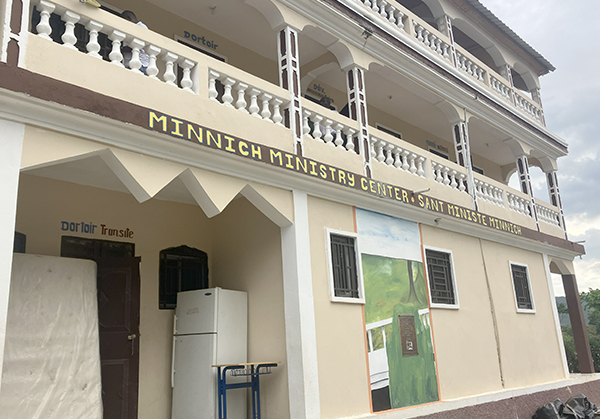
In the last year, the national leadership of l’Eglise des Frères decided to build new headquarters in the city of Saint Raphael, after they had to shut down their headquarters near the capital due to the ongoing violence and insecurity.
The building project received funds from the Church of the Brethren’s Global Food Initiative to build a storefront on the first floor to sell agricultural supplies. The leaders hope to open the store for business yet this year. On that floor is also a guest room for church members traveling through the region.
On the second floor is a guest room with bunk beds and offices for the Haiti Medical Project and the national committee of the denomination when they are in the area.
On the third floor is another guest room and a large eat-in kitchen and dining area. The beauty of this design is that the dine-in area is open on three sides so that the breeze can offer some relief from the heat. It also provided a great view of sunrises, sunsets, storm clouds rolling in over the mountains, and daily life in a Haitian village. We could even identify the latrines the Haiti Medical Project built.
The national committee of the Haitian church all came to the headquarters for this visit. I and the other travelers were happy to meet with those leaders as well as Haiti Medical Project director Jean Billy Telford and coordinator Jurimaine Pierressaint. We heard about their ministries and their plans for future pastoral training and community health projects. I was able to deliver the fresh-off-the-press pastor’s manuals in Haitian Creole from Brethren Press, which were received with gratitude and excitement.
Events with the local congregation
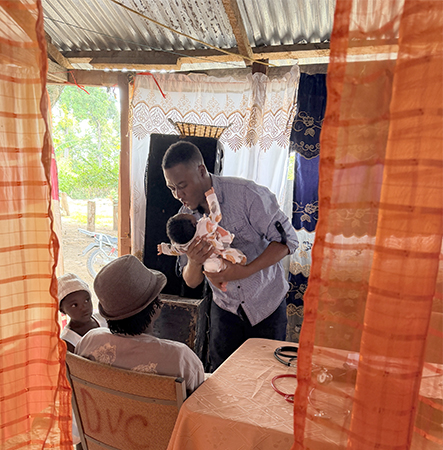
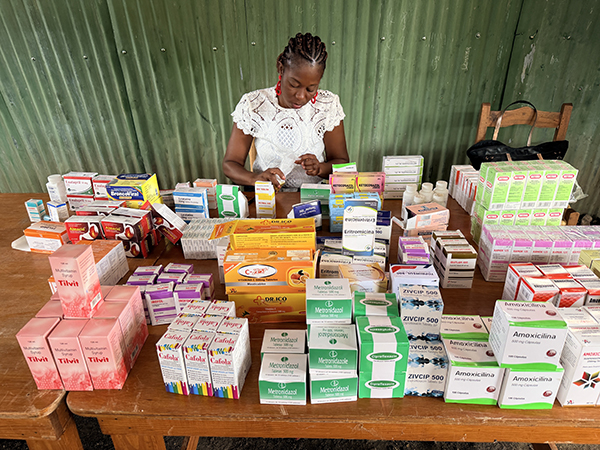
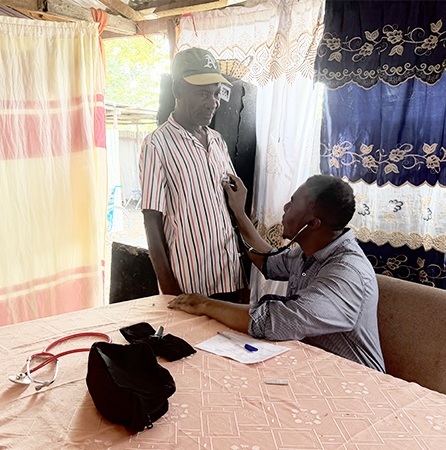
On Saturday, the Haiti Medical Project held a mobile medical clinic in the rooms of the congregation in Saint Raphael. Working in the clinic were two Haitian doctors, a pharmacist, several nurses, and medical technicians. It was a well-oiled machine! After Dr. Ullom-Minnich arrived mid-morning, he joined the work while Ilexene Alphonse translated for him. Dr. Taugher observed, gathering notes on how to say certain things in Creole and how the more experienced doctors were choosing to treat the conditions presented to them with limited pharmacy supplies and without lab testing.
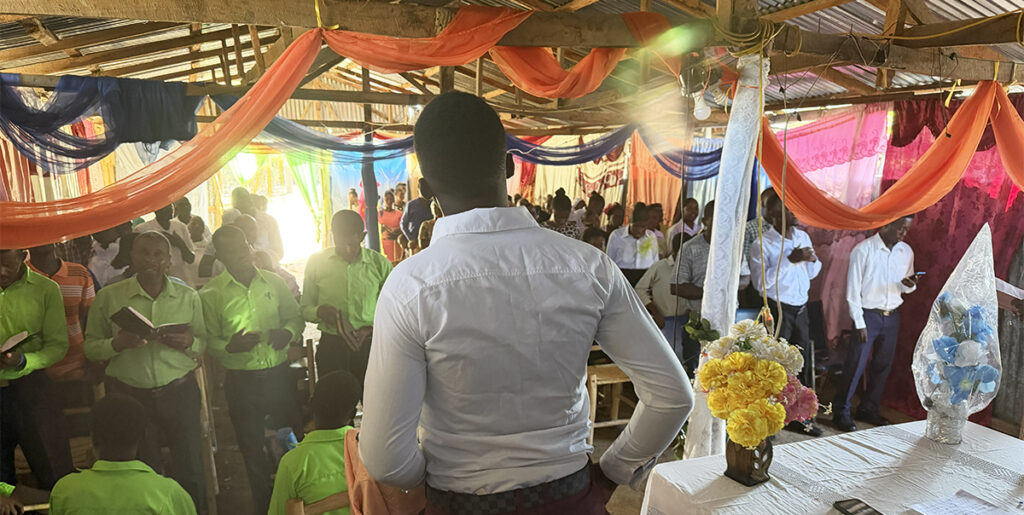
On Sunday morning, I preached at the congregation to a packed sanctuary. One of my favorite passages in relation to global mission is Revelation 22:1-5 about the leaves of the tree being for the healing of the nations. I encouraged the national leaders present, along with the congregation, to see themselves as leaves for healing—for themselves, their communities, and beyond to the borders of Haiti! Everyone has something to give for the benefit of others.
Inaugurating the Minnich Ministry Center
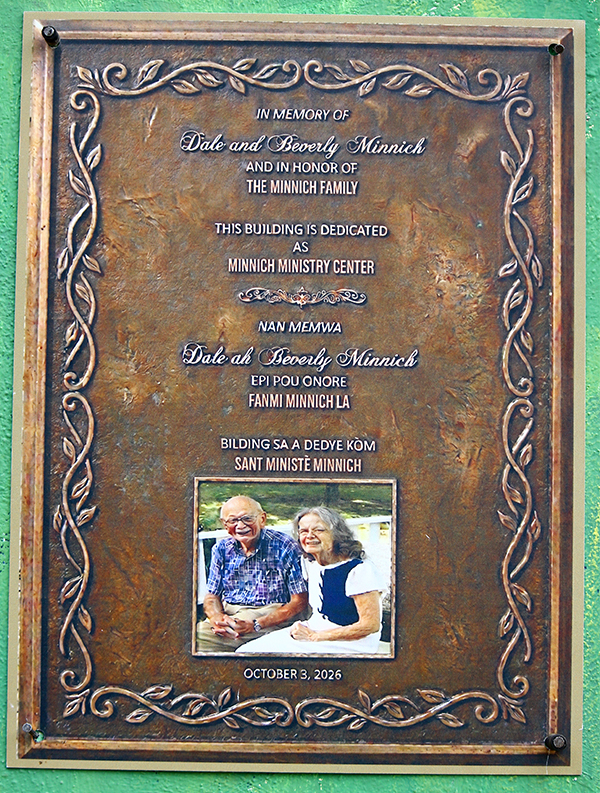
Later in the day, the church’s national committee and the medical project personnel met in the courtyard, facing the new headquarters building, along with us guests. They inaugurated the building and dedicated it as the Minnich Ministry Center named after the late Dale and Beverly Minnich, Dr. Paul Ullom-Minnich’s parents. Dale Minnich, a leader in the Church of the Brethren in the US, had been instrumental in the Haiti Medical Project.
It was a joyous celebration and a special moment for Dr. Ullom-Minnich, who is coordinating the Haiti Medical Project US working group. The inauguration also recognized the contributions of the Church of the Brethren Global Mission, Brethren Disaster Ministries, and Project Piti Pami.
Visits to water projects
On the final full day, we loaded into the Toyota Landcruiser and set out for Ouanaminthe, a city on the border with the Dominican Republic, a four-and-a-half-hour drive. Would it surprise you if I told you it was only about 60 miles? My watch was confused by the bumpy roads and congratulated me two hours into the drive with having attained my 10,000 steps!
We visited the church there, met the pastor and his family, and saw a water project. The well and the reverse osmosis system unfortunately broke down for various reasons and so now is not able to provide clean water for the community around the church. The Haiti Medical Project and the church’s national committee are assessing how best to find a solution so that clean water can be restored.
Next, we went on to Cap Haitien to visit the First Eglise des Freres congregation there and to see their water project. In that area, there was terrible flooding that caused the well to fail and broke the reverse osmosis system. New plans are being made to build a well on higher ground to prevent the same thing from happening should it flood again.
Later that evening, around a feast of chicken, lamb, liver, rice, plantains, and vegetables, I heard more about the work of Jurimaine Pierressaint, the Haiti Medical Project coordinator. She grew up in l’Eglises des Frères and is the only woman I met who has a leadership position. She herself is a nurse and does community projects with women and children across northern Haiti. Some of those projects include maternal health, youth clubs, and help with the mobile health clinics.
She also was in charge of cooking for our visiting group’s sensitive stomachs to keep us from getting sick. I am happy to report that she succeeded not only in keeping us well, but well satisfied with tasty local delights.
God’s provision in times of plenty and in times of need
Since returning from this trip, the passage from Philippians 4:11-20 has been going through my mind.
Paul talks about being content in times of plenty and times of need. He also shares his confidence that God will supply all our needs according to his riches in glory. But he was referring to the church in Philippi sending him money so that he could live and work among them and others. He equates these monetary gifts with fragrant offerings to God. Wow, that’s an image I don’t think of very often!
That passage leaves me wondering how Haitians understand God’s provision and contentment in times of plenty and need. In my quite comfortable middle-class life in the United States, I don’t think I’ve ever had a time of true financial need when there were not sources of funds for an emergency. I have no idea what it means to just try to survive, keep my children fed and clothed, and hope and pray I have enough money to send them to school, like a Haitian mother does.
As a former mission worker for 14 years with the Mennonites, I do know what it means to be blessed by others’ generosity so that you can follow your call to ministry. We lived in Germany, a very expensive country to live in, and we needed help meeting our fundraising goal those 14 years. If churches and individuals had not given generously, that ministry would have come to a quick close. I believe those financial gifts were received by God as a fragrant offering, besides just meeting our earthly need.
I was surprised when a Haitian woman thanked me for making the sacrifice to come visit them in this difficult time. It remains hard to wrap my mind around me making a sacrifice when they live day to day amid so much corruption, uncertainty, and insecurity, not to mention literal times of need for medical services, food, and clean water. That feels like something much more worthy of praise than my few days of lack of comfort.
I am currently reading the book Liturgies for Resisting Empire by Kat Armas, a speaker at National Youth Conference this summer. In one of her prayers she writes, “O God, we resist the temptations of empire: control, comfort, and apathy.” I join in that prayer, as I realize that every time I resist the narrative of empire—that tells me I deserve comfort and control and that I am allowed to be apathetic in the face of suffering—I am more useful in the hands of God. I can see and receive the gifts of our Haitian siblings. I can value and respect them as equal image-bearers of God. I can embrace them as co-heirs in the kingdom of God and co-laborers in the work of lifting up the name of Jesus in all the earth.
May all the gifts given to the Haitian Church of the Brethren and the Haiti Medical Project show our Haitian communities that God does indeed supply all their needs according to his riches in glory.
— Sharon Brugger Norton is executive director of Global Mission for the Church of the Brethren.
#MissionAndMinistryBoard #StrategicPlan #RacialJustice #LoveOurNeighbors #Discipleship #NewTestamentGiving
———-
Find more Church of the Brethren news:
- Direktè egzekitif Misyon Mondyal la fè premye vizit li nan Legliz Frè d’Haiti ak nan Pwojè Medikal Ayiti a.
- Global Mission executive director makes first visit to l’Eglise des Frères d’Haiti and the Haiti Medical Project
- El director ejecutivo de Global Mission realiza su primera visita a la iglesia de los Hermanos de Haití y al Proyecto Médico de Haití.
- D.C. Circuit Court holds that plaintiffs have standing in ‘sensitive locations’ lawsuit
- El Tribunal de Circuito de DC dictaminó que los demandantes tienen legitimación activa en la demanda relativa a “lugares sensibles”.