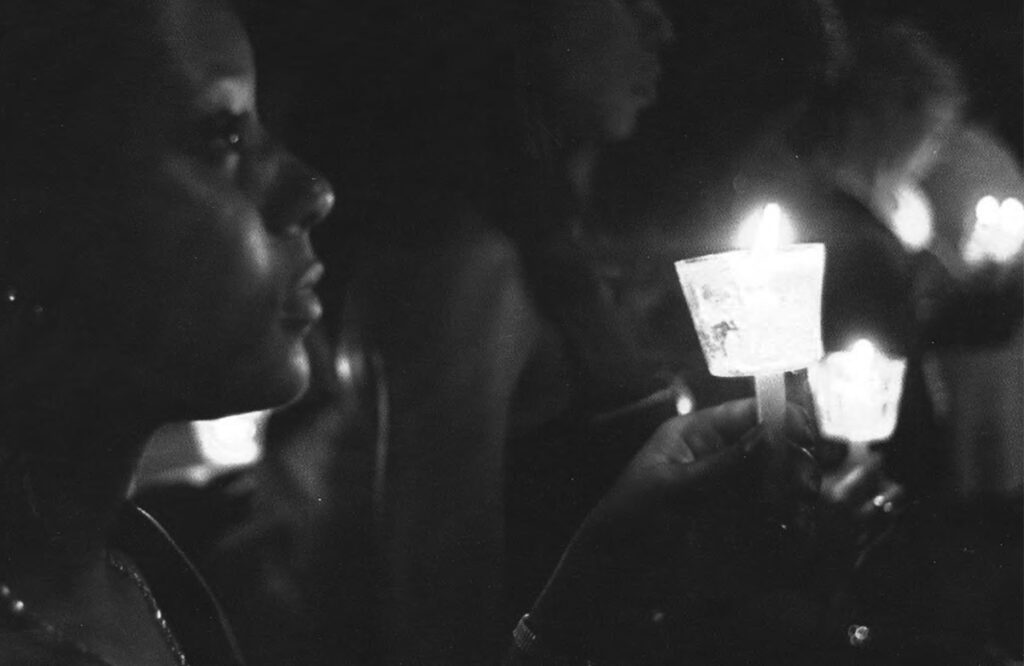
Christ is our peace
A statement from Church of the Brethren general secretary David Steele marking the 25th anniversary of Sept. 11, 2001:
Twenty-five years have passed since the terrorist attacks of Sept. 11, yet the sorrow of that day remains close for many.
We remember the nearly 3,000 people whose lives were taken in New York City, at the Pentagon, and near Shanksville, Pa. We honor those who moved toward danger to help others, and we hold in prayer the families, survivors, rescue and recovery workers, and communities that continue to carry grief, trauma, illness, and loss.
We also remember the suffering that followed. Wars devastated communities abroad and brought lasting loss and trauma to families in the United States. Muslim, Sikh, Arab, South Asian, and other neighbors endured racist and xenophobic discrimination and violence because of who they were—or were perceived to be.
The aftermath of Sept. 11 showed how fear can compound tragedy, turning grief into suspicion, exclusion, and aggression. That danger does not belong only to the past. Today, fear is again being used to divide neighbors, cast people as threats, and justify the pursuit of power.
The church must bear witness to another way.
Scripture proclaims that Christ is our peace and has broken down the dividing wall of hostility between us (Ephesians 2:14). As a peace church, we are called to embody that peace with courage and action. Following Jesus means standing with people harmed by violence, resisting hatred, pursuing justice, and overcoming evil with good.
It also requires us to examine our loyalties. No nation, political party, leader, or ideology deserves the devotion that belongs to Christ. The church must not use faith to justify the pursuit of power or place national interests above love of neighbor.
Our loyalty to Christ becomes visible in how we live with those around us. Being “Jesus in the neighborhood” means moving toward one another, sharing one another’s burdens and gifts, and seeking the well-being of the whole community.
That loyalty must be more than words. At a time when fear pushes people apart, Jesus draws us toward one another—to know our neighbors, listen to their experiences, share one another’s burdens and gifts, and seek the well-being of the whole community.
On this anniversary, we call our congregations to embody that peace with courage and action by:
- Remembering truthfully through prayer, worship, lament, and learning.
- Building relationships across religious, cultural, and political differences, rejecting language and actions that diminish or dehumanize others.
- Practicing healing through service, conflict transformation, and solidarity with those experiencing violence, exclusion, isolation, or hardship.
We cannot undo the violence of Sept. 11 or the suffering that followed. But we can refuse to let fear have the final word. May God comfort all who mourn and give us courage to follow Jesus toward one another, embodying his peace wherever we live.
For the glory of God and our neighbor’s good,
David A. Steele
General Secretary
Church of the Brethren
What we did: In response to 9/11, the Church of the Brethren waged peace
The Nov. 2001 Messenger (download here), the first issue of the Church of the Brethren magazine to appear after the 9/11 attacks, surveyed the peaceable responses of Brethren across the country. Here is an excerpt:
As talk of war swirled through the nation’s capital and elsewhere in the weeks following the Sept. 11 terrorist attacks along the East Coast, Brethren were seeking to respond with acts of peace and love.
The Brethren Service Center quickly became a hub of activity. The Emergency Response/Service Ministries activated childcare teams, prepared needed supplies and funding, and set up an emergency field office for Church World Service personnel.
A $25,000 grant from the Emergency Disaster Fund was approved the day following the attacks, and Child Care in Aviation Incident Response (CAIR) volunteers were soon on their way from points as far away as Nebraska. By the weekend, three CAIR teams with 18 volunteers had headed to New York. Working in a converted warehouse on one of Manhattan’s Hudson River piers, they helped children cope with the tragedy. As the initial CAIR teams finished their assignments, other volunteers from the Disaster Child Care program began work in New York.
Local relief efforts took place through the two Church of the Brethren congregations in the New York area, Brooklyn First and First Haitian. “The city is slowly pulling back together,” Brooklyn First associate pastor Phill Carlos Archbold said two weeks after the attacks, “but there’s a lot of fear.” Church members helped to distribute face masks and blankets the day of the attack and other supplies thereafter. Later, he said the church’s emphasis turned to helping people through bereavement, doing “a lot of listening.” One of the victims of the World Trade Center attack, Joseph Anchundia, was from a family that had long been part of Brooklyn First. The church also planned a memorial service in honor of the firemen from the area who lost their lives, and sought to support its many Arab members.
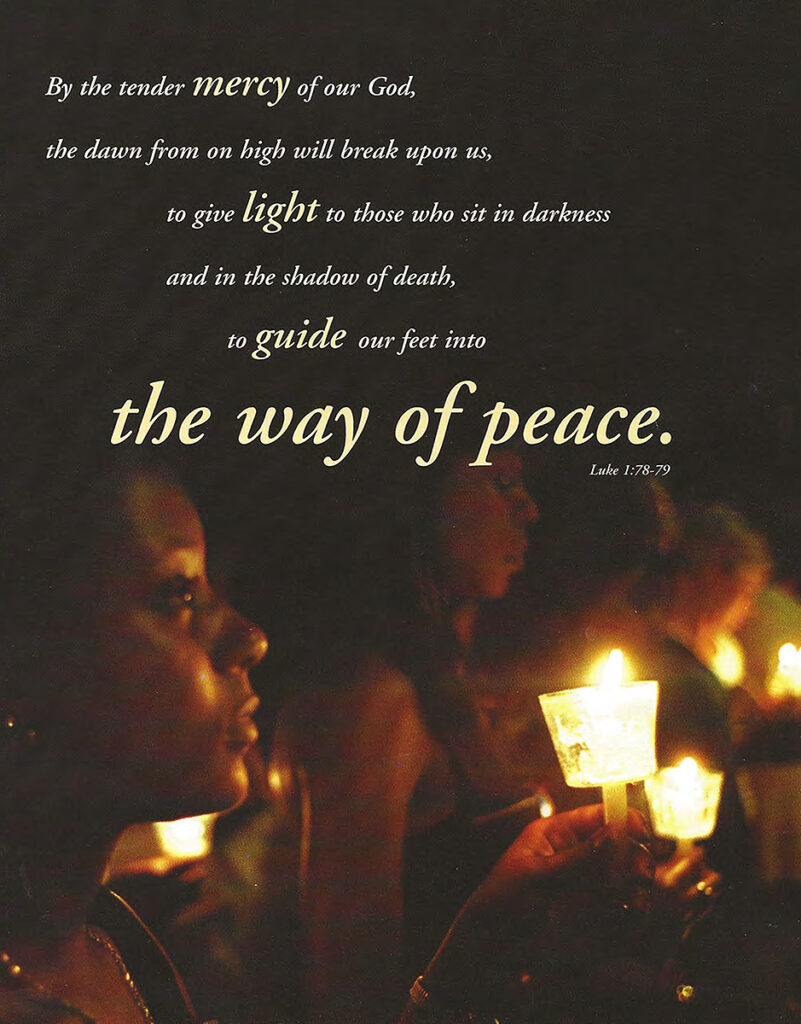
Brethren Press equipped congregations by creating an online pool of resources titled “The Way of Peace” and also asked pastors and others to send in worship resources they had created.
On Earth Peace began a new initiative titled “Seeking Peace.”
Prayer services took place at hundreds of churches and others participated in community and/or interfaith services. On the Antietam battlefield, Frederick (Md.) pastor Paul Mundey led a service in the historic Dunker meetinghouse. Near Toledo, Ohio, the Lakewood congregation sent a letter of support to an Islamic community center in the city. In La Verne, Calif., some Brethren provided support for an Islamic school in nearby Pomona. In Lebanon, Pa., the Brethren Disaster Auction marked its 25th anniversary by raising well over half a million dollars for disaster relief.
What we said: Remember who we are
The Nov. 2001 Messenger (download here) also shared statements and prayers from a wide variety of people including denominational leaders. Here are excerpts from some of those statements:
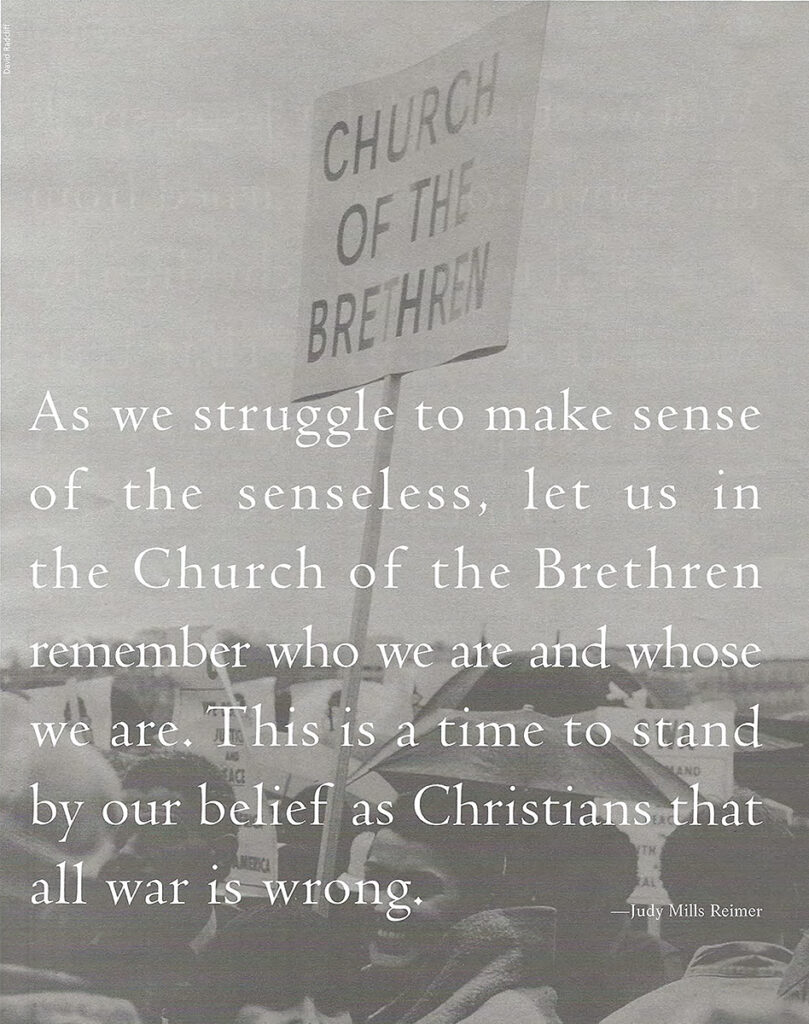
Remember who we are and whose we are
As we struggle to make sense of the senseless, let us in the Church of the Brethren remember who we are and whose we are. This is a time to stand by our belief as Christians that all war is wrong. Let us urge our government to respond in ways that do not escalate the level of violence and result in the loss of other innocent lives. Let us be instruments of healing in our neighborhoods, where people of other faiths and backgrounds are being unfairly targeted. Let us, out of our Church of the Brethren convictions, continue to witness to Jesus’ gospel of peace.
—Judy Mills Reimer, general secretary of the Church of the Brethren.
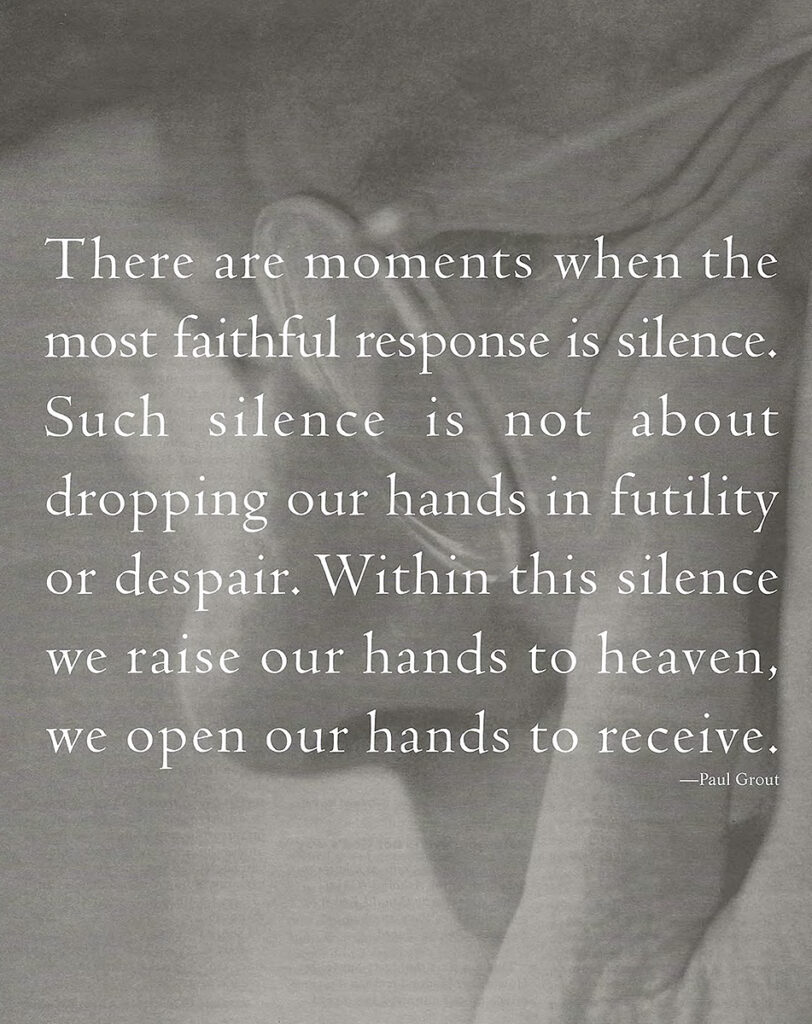
A season of silence
We can mourn with those who mourn. We can stand with those persecuted on account of their sharing a common ethnic and religious background with those who have committed a horrible crime. We can enter a holy silence. There are moments when the most faithful response is silence. Such silence is not about dropping our hands in futility or despair. Within this silence we raise our hands to heaven, we open our hands to receive.
—Paul Grout, moderator of the Church of the Brethren Annual Conference.
A prayer for peacemakers
Great, loving, eternal God: Even as we share with our countrymen the sadness, the anger, and the great sense of violation that these horrible acts of terrorism have caused, give us the courage to remain true to our own best selves as members of the Church of the Brethren.
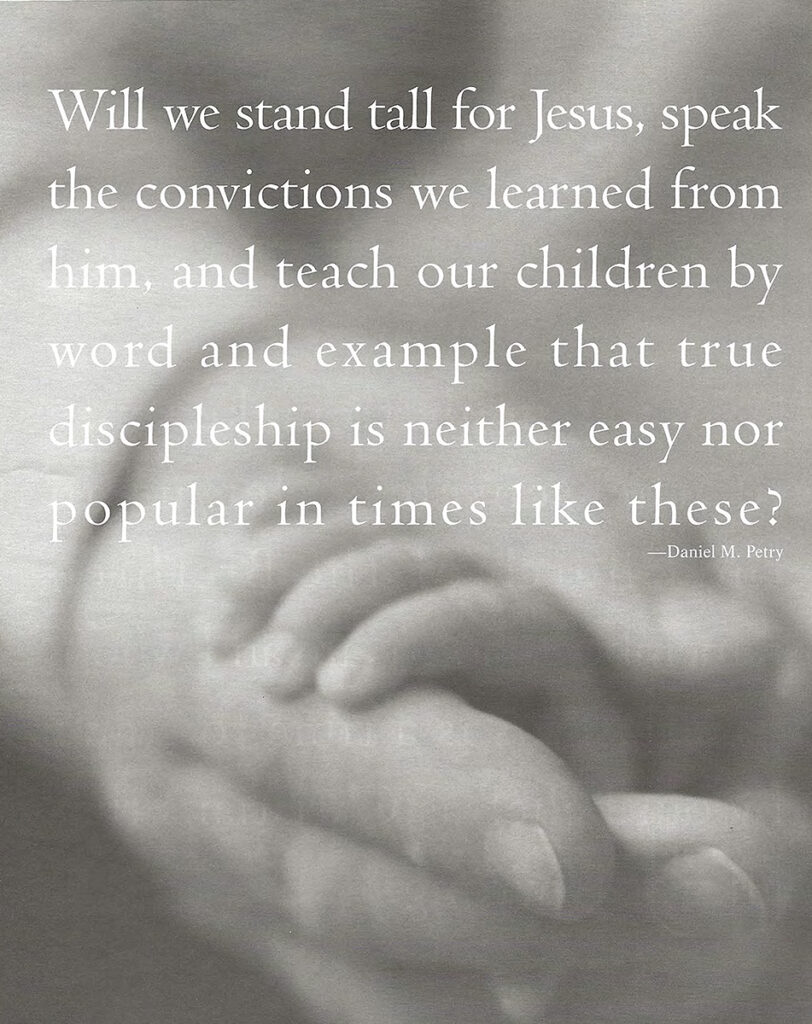
We have come once again to a time of great testing. Sabers are rattling; war fever grows more intense with each passing day. Will we, your church, hide in a corner, say nothing about our convictions, and let violence have its way throughout our land? Or will we stand tall for Jesus, speak the convictions we learned from him, and teach our children by word and example that true discipleship is neither easy nor popular in times like these?
Lord, you told us to love our enemies and pray for those who persecute us. It will take great fortitude for us to do so. It will require boldness to remind our sisters and brothers of this command. Many, if not most, will think we are speaking nonsense. Our words may be lost in the hot wind of war rhetoric. But, O Lord, we believe in your way. We have seen the power of the cross—the power of love to conquer evil, the power of grace to transform hearts of stone. And we have seen the power of the Resurrection.
—Daniel M. Petry, from a prayer delivered at the Northern Indiana District Conference.

Returning evil is not God’s way
My belief in God, as manifested in the life and teachings of Jesus Christ, calls me to practice in my living the type of love Christ showed when he was confronted with evil and violence. In many instances he was able to face evil with the power of love and turn the tables to thwart the evil intent. When he was overpowered by violence, he did not resist but forgave his attackers. He did this knowing that there were those that followed him capable of establishing his church; and he did this in complete trust of God’s ability to bring about good from his suffering and death.
I cannot speak for those who have lost loved ones, who are injured and suffering at this moment, who have been traumatized emotionally in unimaginable ways. I do not know for sure what I would do in similar circumstances. But I am more deeply convinced since the tragic events of Sept. 11 that returning evil for evil is not God’s way.
—Donald Parker, chair of the former General Board of the Church of the Brethren.
Our new vulnerability
We in this nation are no longer an island of tranquility, protected by oceans, affluence, fences, from the violence that plagues so many of our global neighbors. We suddenly know ourselves to be vulnerable. But this vulnerability also provides opportunities, should we be able to seize them once the dust has cleared and our passions subsided. For one, we can now better empathize with vulnerable people all around the world, for whom walking to school in a hostile environment, or going about village life even while threatened by government bombers, or coming home to an abusive spouse is a daily exercise in gut-wrenching vulnerability. Perhaps we will be moved to stand more closely by them, minister more substantially to them, and take up their cause with a passion born of those who can now empathize rather than merely sympathize.
—David Radcliff, director of Brethren Witness for the Church of the Brethren.
A letter to Brethren youth
I am sorry that the church is not in better condition as you face these times. We older adults have left you with the impression that church should entertain you and that being a Christian is fun. We have not taught you very well that faith is total life commitment to Jesus Christ that includes joy and sacrifice.
We have left you with a church that gives the impression that you should pick and choose what parts of Christian faith are comfortable to you, and disregard the rest. Faith is the church’s collective witness to Jesus Christ, not a matter of preferences.
Sometimes we talk about peace as though its only purpose is to secure international political stability. We have not spoken clearly enough that disciples of Jesus trust in and work for his peace, regardless of the condition of international politics.
Some will say that the way of peace amounts to failure to defend our country, and is a cowardly way to avoid the dangers of war. Remember that in terrorist war, all civilians are military targets who share constantly the danger of death. Christians are willing to live and to die for their faith, but not to kill for it, nor for a political institution.
Some will say that peace is passive. Remember that at the hour of his arrest, Jesus healed one of his would-be attackers, after Peter struck him with the sword. Disciples of Jesus can be just as active in healing, for those who have lost loved ones, and hopefully for the many innocent civilians in harm’s way by the threat of international military force.
—Jeff Bach, a minister and professor at Bethany Theological Seminary.
When they use God’s name
What do people mean when they use God’s name in a time of national crisis? It’s hard to be critical of an apparent religious awakening across the country, but is it really about God? More important, is it benign? Who can identify the moment when the phrase evolves from a heartfelt prayer for national healing to a statement of manifest destiny?
As a people who seek to follow Jesus, we in the Church of the Brethren should be alarmed when God’s name is used to justify our nation’s participation in war. We don’t believe God is blessing misguided but religiously inspired terrorists. Should we believe that our bombs are any more pleasing to God than theirs?
—Wendy McFadden, Messenger publisher.
#MissionAndMinistryBoard #StrategicPlan #RacialJustice #LoveOurNeighbors #Discipleship #NewTestamentGiving
———-
Find more Church of the Brethren news:
- Annual Conference moderator shares theme statement for 2027
- El moderador de la Conferencia Anual comparte la declaración temática para 2027.
- Moderatè konferans anyèl la pataje deklarasyon tèm pou 2027 la
- What faithful witness asks of churches today: CCT’s 20th anniversary forum
- Sa temwen fidèl yo mande legliz yo jodi a: fowòm 20yèm anivèsè CCT a