Church of the Brethren Global Mission executive Sharon Brugger Norton visited the Church of the Brethren in Burundi in late March and early April. The Church of the Brethren in Burundi is the newest member of the Global Church of the Brethren Communion.
She arrived in Burundi on March 29, for the trip that included spending Holy Week in Burundi. She was led on a tour of the churches in Burundi by Expert Bukene, founder and lead pastor of the Church of the Brethren in Burundi, accompanied by several other Burundian church leaders. She also met with church leaders from the Democratic Republic of Congo (DRC).
Visits to many congregations in Burundi
Norton visited many congregations of the church in Burundi, over the course of just a few days, and got to know more about them and their ministries. The denomination has five church districts that match the political regions in the country. Within those districts there are parishes that are clusters of congregations located close together. The 52 local congregations have been planted since 2015, Norton reported. Those that are renting a church building, or have land but not enough money to build, are all seeking funding to build permanent church buildings.
She discovered a variety of ministries among the congregations. The visit to the congregation in Gitega, for example, included a stop at their soap factory and a plot of land where they demonstrate the Farming God’s Way training that is funded by the Global Food Initiative. She was able to visit a congregation who built a permanent building with funding directed to the project by Brethren Disaster Ministries.
Since it was Holy Week, Norton participated in a lot of church services, including a love feast held on Maundy Thursday evening. “They now have the tradition of eating lamb and ugali (cassava). It was incredibly delicious.”
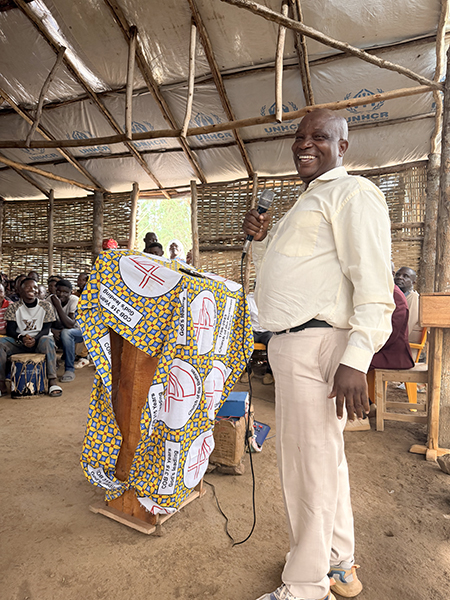
“In every church I am asked to bring greetings and to say a few inspiring words. I try to listen to the Spirit’s leading instead of relying on a canned speech to use over and over,” Norton reported. In one isolated community, after seeing many children in the church, she was moved to say a prayer of protection over the children and their parents.
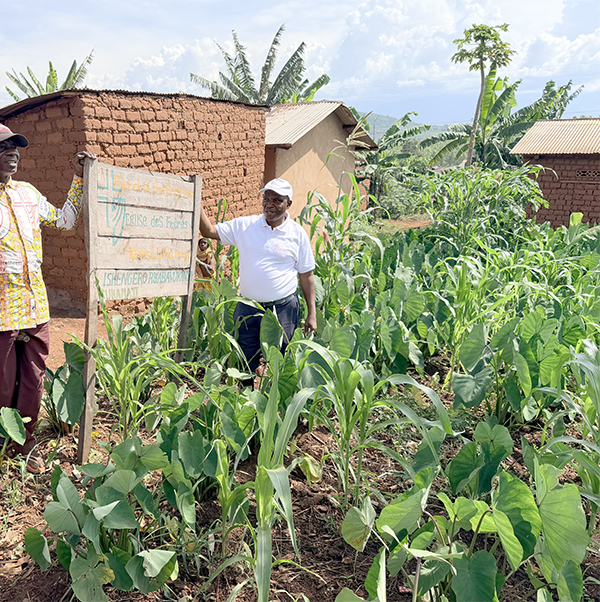
Bukene has helped the Church of the Brethren in Burundi stay free of dependency on the US church, Norton reported. One example is a medical clinic owned by Bukene that provides livelihoods to the workers at the clinic as well as medical care to people in need, and also contributes some funding to the church.
“Because of Expert’s good role model of donating so much to the Church of the Brethren and helping so many people improve their lives, other leaders have been inspired to follow his example,” she found. “In one town, we met a man who had donated three properties to the church. He also had a bakery on the premises, which helped generate income for him and the church. He would like to sell the church property next to his house to the national church. The bread was delicious, by the way!”
However, members and districts of the Church of the Brethren in the US are contributing financially to the success of the church in Burundi. One example is mission volunteer Chris Eliott’s support for the Brethren School and International Pastors Institute in Burundi as well as the Great Lakes Bible School in Rwanda. Money raised by Virlina District supports the Church of the Brethren in Burundi, and money raised from various sources has purchased a Toyota Landcruiser for the use of the church in Burundi.
She spent two mornings with Elliott, teaching at the International Pastors Institute. “They have three levels,” she reported. “One is for beginners who are training to be Church of the Brethren pastors. The second one is for those who have more capacity and already have some university training. The third level is for the ones who are doing the teaching, and who are building their own capacity.”
Visit to a refugee camp
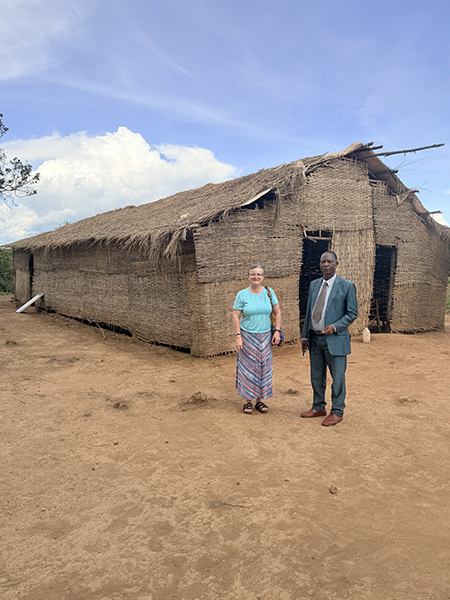
Norton visited a refugee camp in the Rutana region near the Tanzanian border. The Church of the Brethren in Burundi is building a congregation just outside the camp. The building “was the only example of stick, mud, and thatch that I saw the whole time I was there,” Norton reported, and the congregation is seeking funding for a permanent building. In the congregation are Burundians and Congolese refugees. “I encouraged them to be one in Christ and not let their cultural and linguistic differences cause division,” Norton reported.
At the refugee camp, she saw many shanties built by the UNHCR (United Nations High Commissioner for Refugees). The church leaders who accompanied her estimated the number of people in the camp to be in the tens of thousands, perhaps as many as 100,000. Although there was no consensus on the number, “in any case, no one has enough of anything, and there are no schools for the children,” Norton learned.
Meeting with church leaders from the DRC
Church leaders from the DRC came to Burundi to meet Norton during the trip. They included church founder and lead pastor Ron Lubungo and his wife, Manzawana, and several others. Among them was at least one denominational officer who himself is displaced and with his family is living in a refugee camp.
Norton learned that the Church of the Brethren in the DRC now has 34 congregations and a membership of 10,587. The churches are located in South Kivu and North Kivu Provinces and in the cities of Tanganyika, Katanga, and Kinshasa.
The violence that has overrun the eastern DRC has meant no peace or security for the church and its members. “When war is happening churches get robbed,” she heard, and even have been destroyed. You cannot overestimate the impact of war on the church, one pastor told her. When war came, people stopped going to their jobs, which stopped development of the church because it collapsed the church’s financial system.
“People have also been robbed personally,” she reported. “Some have had compounding illnesses, and even death. They are struggling to live daily.” When the fighting was at its worst, whole cities were captured by rebel military groups, borders were closed as well as banks and work places, and farmers couldn’t tend their crops. Food supplies were cut off, which led to malnutrition. Many tens of thousands of people fled and became refugees.
Trauma experienced by DRC church leaders has included being cut off from their families and communities by the fighting. One was caught in Rwanda during fighting last year, when the border was closed. He was unable to contact his family or other church leaders because communications were down. “He was afraid. Many had this situation of trauma.”
In this difficult situation, the church in the DRC has made the decision to prioritize care for refugees. The situation of refugees—including both Burundian Brethren and Congolese Brethren—continues to be dire. Refugee camps are overcrowded, the UNHCR is underfunded, there is a lack of shelters and lack of water as well as hunger and malnutrition. Sickness and lack of care for children has led to the deaths of children.
Life for women in the camps, and in society in general, carries additional risks and difficulties. “Women are not valued like men, sadly,” Norton reported. “War has been going on more than 30 years and women and children are the most vulnerable and victims of rape. That leads to isolation.” She heard from church leaders that women are facing challenges, some have no money, some have lost children, some have died, so the women’s ministry in the church has been weakened.
Community projects and priorities in the DRC
Community projects of the Church of the Brethren in the DRC include agricultural projects such as a well providing irrigation for a farm that helps those in need and the Batwa people, formerly known as pygmies. This was funded by the GFI.
A community development project started at the end of 2024 as a center for women’s empowerment has had to stop activities due to the war. Leaders hope to continue the work to positively impact the local economy, which will benefit more than women. “They want to provide help for teaching and reintegrating refugees,” she reported.
Additional hoped-for projects include a project for eco charcoal transformation, which also helps environmental protection and their own safety, as well as projects to plant trees, do trauma healing, and build financial autonomy through small business/micro-finance. The church already has been working with Mennonite Central Committee for providing and training for trauma healing.
Priorities of the church in the DRC include:
— holding a workcamp to build a peace center in Goma
— carrying out evangelism all over the country
— buying land and building churches
— producing books for strong training to evangelists and for congregations
— music instruments and sound systems for evangelism crusades
— sustaining Christian education and theological and leadership training
— peace education
— care for orphans and their education
— building a health clinic in Ngovi
— emergency relief for those affected by war
— women’s empowerment
— continued disaster ministry
Disaster work continues
In the group of DRC church leaders was Dieudonné Faraja Chrispin, who works with Brethren Disaster Ministries serving the needs of refugees in the region. He is a nurse with a master’s degree in community health who lectures at the university in Goma. He started the disaster ministry in 2021 when a volcano erupted in North Kivu Province. His job now entails moving between Goma, Uvira, and Bujumbura due to the instability and the needs of the refugees.
Another disaster ministry worker who was among those meeting with Norton was still walking with difficulty after having suffered a spinal injury during a Brethren Disaster Ministries trip some months ago. He needs a second surgery, “but back surgeries are never a sure thing and very expensive,” Norton reported. Aid for his surgery is a request being made by Global Mission.
Norton closed her reporting with a prayer for the Churches of the Brethren in Burundi and the DRC, and for the good works of the Lord of these faithful church leaders.
Find out more about the Global Mission of the Church of the Brethren at www.brethren.org/global
#MissionAndMinistryBoard #StrategicPlan #RacialJustice #LoveOurNeighbors #Discipleship #NewTestamentGiving
———-
Find more Church of the Brethren news: