By Frank Ramirez
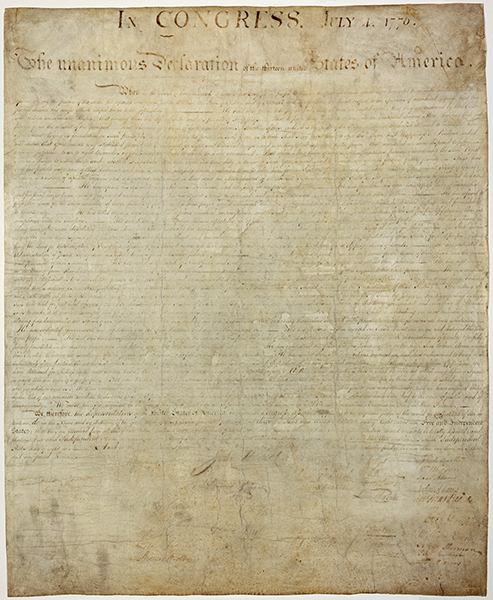
“As we approach the 250th anniversary of the event that kicked off the revolution, we might ask, what do we Brethren think about the Declaration of Independence? … And what would our forebears say about what we’ve become?” asked Denise Kettering-Lane at her standing-room-only equipping session titled “Dunkers and the Declaration of Independence: Then and Now.”
A Church of the Brethren historian, Kettering-Lane is associate professor of Brethren Studies at Bethany Theological Seminary.
She admitted that for many Church of the Brethren members, the 4th of July is simply a time to celebrate with specialty ice cream flavors—a comment that drew applause from the crowd.
The revolutionary era “was a period they [the early Brethren] were working in real time to decide what their interaction with government should and would be,” she told her audience.
At the time, the majority of Brethren were second- or third-generation farmers who were largely unaffected by the issues of taxation that vexed many business owners and city dwellers. They were grateful to the King of England for the economic opportunities they found in the Colonies after experiencing crushing poverty and persecution in Europe. They were troubled by the loyalty oaths demanded by the Pennsylvania authorities seeking independence. They also tended to interpret biblical proof texts that urged believers to accept all government as instituted by God.
The records of the Annual Meeting minutes from this time period are spotty, and it is not always clear that the Brethren met every year. While there is really no record of how the Dunkers responded to the 1776 Declaration of Independence, almost a year earlier Brethren in Maryland seem to have had a different experience from their Pennsylvania co-religionists. A declaration of freedom issued by Maryland on July 26, 1775, includes several signers with Dunker names. In any event, Brethren in Pennsylvania were hesitant about any sort of political engagement.
The Declaration of Independence is “not an overtly religious document,” Kettering-Lane said, “that outlined abuses with a list of complaints and laid out the case for a right to change government, absolving allegiance to the British Crown.”
Pennsylvania required all residents to take an oath of allegiance. At the 1779 Annual Meeting, the Brethren—who were against oaths of all kinds—outlined disciplinary measures for those who took the oath of allegiance. Meanwhile, in Maryland, Dunkers and people in other nonresistant traditions such as Mennonites and Friends (Quakers), had the right of affirmation instead of an oath. However, there were stiff fines, sometimes as much as 20 pounds, which would be worth up to $10,000 in today’s currency.
Meanwhile, prominent Brethren leader Christopher Sauer II, who inherited his father’s colonial press some years earlier, was in the process of handing it over to his sons, Christopher III and Peter. Although Christopher Sauer II was politically neutral, Christopher Sauer III was an active spy for the British. “The press was prohibited from publishing anything political,” Kettering-Lane said. Eventually the Sauer press was dismantled and destroyed by self-styled patriots, and Christopher Sauer II was tormented and left impoverished. Christopher Sauer III ultimately fled to Canada after the war.
Brethren in the 19th century favored a sober celebration of July 4, condemning all worldly amusements. Brethren in the 20th century had a most positive outlook, using the pursuit of happiness as an anti-war talking point. “Military destroys happiness,” Kettering-Lane said.
Following World War II, the phrase from the Declaration of Independence that “all men are created equal” was used to justify nonviolent independence movements around the world, such as India’s resistance to Great Britain. A 1950s Civil Rights statement that also condemned antisemitism referenced the document. Attitudes about the Declaration of Independence in the Church of the Brethren magazine Messenger involved using it to call for redress for Japanese internees, when reporting on a 1981 Annual Conference statement.
Kettering-Lane suggested some options for Brethren to celebrate the 4th of July:
- Ignore it. Silence is an option.
- A restrained response, like the 19th century Brethren.
- Recognize that soaring rhetoric and promises did not measure up at the time of the Declaration of Independence—and still don’t. Be better versions of ourselves. Stand up against racism and for immigrants.
- Admit it led to war. Lament the hardship and loss of life that resulted, and that even its beneficial changes came at a cost to others.
- Just eat ice cream.
— Frank Ramirez is a member of the Annual Conference Press Team.
———-
Find more Church of the Brethren news:
- Brethren Volunteer Service Unit 340 completes orientation
- La Unidad 340 del Servicio Voluntario de los Hermanos completa la orientación.
- Inite Sèvis Volontè Frè yo 340 fini oryantasyon an
- New Pastor’s Manual in Haitian Creole and French to be used in Haiti and Africa
- Nuevo manual para pastores en criollo haitiano y francés para ser utilizado en Haití y África.