By Hannah Nelson and Marcia Sowles, Office of Peacebuilding and Policy
Aug. 6 and 9 mark 80 years since the atomic bombings of Hiroshima and Nagasaki. The bombings resulted in a combined death toll of approximately 200,000 to 250,000 people by the end of 1945. In Hiroshima, it is estimated that 70,000 to 140,000 people died, while in Nagasaki, the estimated death toll was 39,000 to 74,000. These figures include both those killed immediately by the blast and those who died later from radiation sickness, burns, and other injuries.
Even before the actual bombings, Americans suffered the consequences of the fall-out from the first nuclear test (code named “Trinity”) on July 16, 1945, in New Mexico. Because the test was clouded in secrecy, no warnings were made to the local community. Radiation levels in some of the counties downwind from the test reached 10,000 times current acceptable limits. Nuclear fallout spread much farther, across thousands of miles, eventually reaching as far as upstate New York (see www.washingtonpost.com/opinions/2025/07/15/atom-bomb-trinity-victims-survivors and https://thebulletin.org/premium/2023-07/collateral-damage-american-civilian-survivors-of-the-1945-trinity-test).
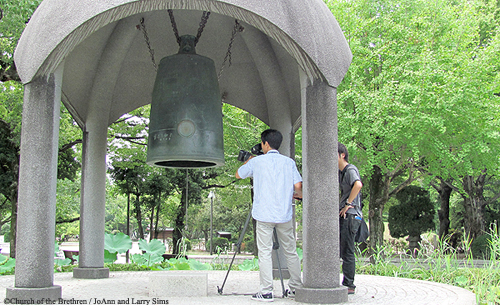
Twelve young girls attending a camp near the test site were awoken by the thunderous noise and bright lights from the test. Later that day, they were excited to see fine white power falling like snow from the sky. Not knowing the danger, they caught the mysterious “snow” on their tongues and played in it as it piled up on the ground. They would later, however, suffer the deadly consequences of the radiation: only 2 would live past the age of 40.
Over the decades, some progress has been made with international agreements to limit and ban nuclear testing and to reduce the number of nuclear weapons and limit their spread. But, as David Cortright, a professor emeritus at Notre Dame University and co-founder of Win Without War, warns in an insightful article in The Nation (July 6, 2025), “The risk of nuclear war is greater now than in decades” (www.thenation.com/article/world/nuclear-war-russia-north-korea-arms). As he explains, both Russia and the United States are engaged in upgrading their nuclear arsenals. China, India, and Pakistan also are expanding their nuclear weapons systems, and North Korea is continuing its nuclear program.
Although the United States, in support of Israel, bombed Iran to block its uranium enrichment program, Israel remains silent about its own estimated arsenal of 80 nuclear weapons. As Cortright stresses, “[T]he mounting nuclear peril demands action,” and the building of coalitions with current social justice groups, “especially when huge increases in nuclear spending come at the expense of urgently needed social programs.” As an example, he cites a slogan developed by Win Without War and other groups at the time of the strikes against Iran and the budget debate in Congress: “Healthcare Not Warfare.”
Congregations and individuals can take action to remember the devastation of the nuclear bombings and advocate for eliminating the threat of nuclear weapons and the reallocation of our resources.
Congregations can include reflections on the 80th anniversary in sermons or prayers in worship services, or host special prayer vigils. Individuals can attend events commemorating the 80th anniversary: see www.mobilize.us/backfromthebrink and www.voices-uri.org/nuclear-prayer-day (the latter link includes virtual as well as in-person events).
Individuals also can contact their representatives in Congress, encouraging them to support resolutions such as House Res. 317 that lays out how we can fundamentally reform US nuclear weapons policy and achieve a world free of nuclear weapons (see https://preventnuclearwar.org/take-action-hres317). Also aligned with this is Senate Res. 323.
Individuals may join other organizations advocating for a federal budget that promotes healthcare, education, and other programs rather than nuclear weapons. Advocacy may be by participating in rallies or writing letters and making phone calls, or both.
Church of the Brethren members may take heart in the continuing work of Brethren Volunteer Service volunteers at the World Friendship Center in Hiroshima. BVSers have served as directors of the center for some decades now, with the current directors being Brad and Sue Cox of Lynchburg (Va.) Church of the Brethren. An action a congregation or individual may take is to help provide financial support for the work of Brethren Volunteer Service as it supports volunteers at World Friendship Center (see www.brethren.org/bvs/projects/1129).
Although the increasing nuclear threat can seem overwhelming, it is important not to give up hope or fail to take action. In the aftermath of the devastation of the atomic bombings, the children of Hiroshima sent colorful drawings of hope to the All Souls Church in Washington, D.C., in gratitude for the art supplies that the church had sent them following the bombings (see https://all-souls.org/social-justice/heiwa). Their hopeful drawings should be reminders to us as well, to not give up hope and to continue to work for peace.
— Hannah Nelson, a Brethren Volunteer Service worker, and Marcia Sowles, an attorney and Policy and Governmental Affairs associate, volunteer for the Church of the Brethren’s Office of Peacebuilding and Policy.
#MissionAndMinistryBoard #StrategicPlan #RacialJustice #LoveOurNeighbors #Discipleship #NewTestamentGiving
———-
Find more Church of the Brethren news:
- Brethren Volunteer Service Unit 340 completes orientation
- La Unidad 340 del Servicio Voluntario de los Hermanos completa la orientación.
- Inite Sèvis Volontè Frè yo 340 fini oryantasyon an
- New Pastor’s Manual in Haitian Creole and French to be used in Haiti and Africa
- Nuevo manual para pastores en criollo haitiano y francés para ser utilizado en Haití y África.