By Frank Ramirez
Talk about Towering Babel. It happens when a Boomer asks for coffee in a restaurant and the Gen Z waiter waits for some clarification because for them asking for coffee is like asking for a potato. And it just might elicit the Gen Z Stare.
Same planet. Different worlds.
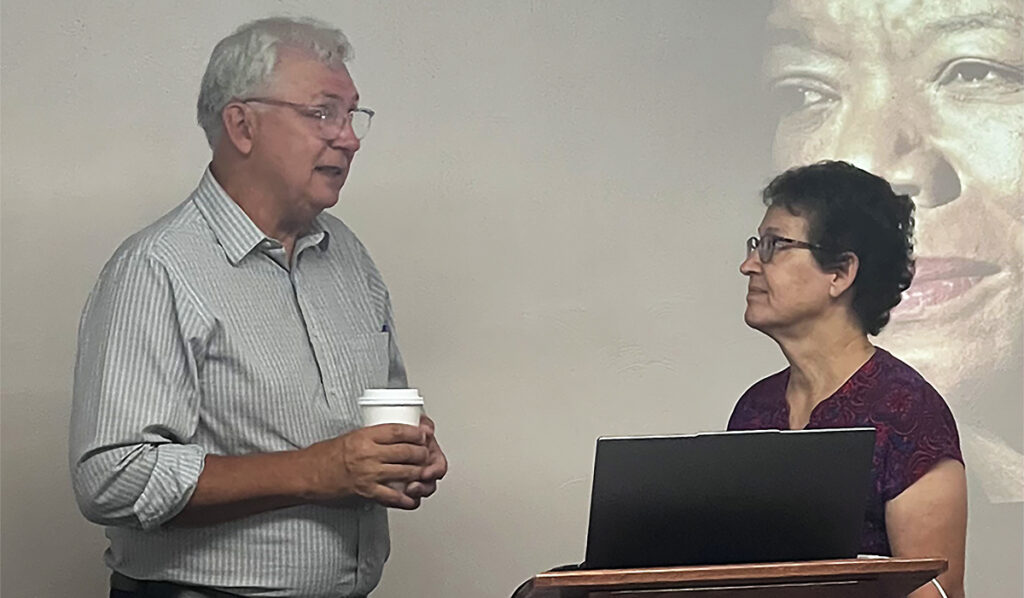
At least that’s according to Jay Wittmeyer, well known in Church of the Brethren circles as a former Global Mission executive, currently executive director of the Lombard (Ill.) Mennonite Peace Center. Wittmeyer was leading a workshop titled “Restorative Conversations” on Aug. 29 at Rock Run Church of the Brethren outside of Goshen, Ind. He was there at the request of the congregation and the Shalom Team of the Church of the Brethren’s Northern Indiana District.
Wittmeyer shared the above coffee order story as an illustration of what he called “the challenge of the normative,” about how very different expectations make conversation difficult among people who think of themselves as similar.
He explained that those in the “Boomer” generation think of coffee as served black in a refillable cup, with sweeteners and creamers at the table to be used at the consumer’s discretion. However, just as most of us would specify if we wanted our potato baked, French fried, home fried, or as hash-browns, a Gen Z waiter expects customers to specify how they want their coffee served—hot, cold, iced, with various added flavors, creamers, whips, and other additives. The “Gen Z Stare” is in lieu of pointless conversation, because, after all, as one of those in the Gen Z generation may be thinking, “I’m not your circus monkey.”
Generational differences are just a few of the many barriers preventing communication between well-meaning folk who think they have a lot in common, Wittmeyer said. There are even more barriers between people of less goodwill.
He began the day-long workshop listing three things Anabaptist Christians might agree about: Jesus is the center of our faith, community is the center of our lives, and reconciliation is the center of work. He then carefully explicated the scripture passage from Ephesians 4:2-6 in light of the difficult work the Apostle Paul faced encouraging the multicultural, multiethnic churches of Ephesus. It’s not as easy as one thinks to bear each other with love, maintain the unity of the Spirit in the bond of peace, while sharing a call.
For them, or for us
Recalling his work in Nepal and Bangladesh, Wittmeyer suggested it is easier to recognize cultural differences among people with radically different national backgrounds. In the US, we mistakenly assume we share the same attitudes, aims, and goals. Sociologists and historians suggest that the several migrations to this continent have created at least 11 distinct regions with their own cultural viewpoints and expectations. People of goodwill with different histories and different expectations may use the same words and yet speak totally different languages. We can’t assume we’re all on the same page, working together to advance the work of Christ.
In addition to regional and cultural differences, Wittmeyer outlined how the variously defined generations have very different expectations about goals and timelines when it comes to life, as well as outlooks on meeting the expectations of others—from the Silent Generation and the Boomers through Gen X, Millennials, Gen Z, and the Alpha Generation.
Whereas some Christians would affirm the statement, “Church embodies the radical nature of Jesus, upending the power of injustice,” others would affirm, “Church is the institution that embodies Judeo-Chrisian culture and values.” But most would find themselves at different places on a spectrum between those poles, and this hinders conversation.
For some the easiest answer is simply to say nothing in an uneasy peace, or to walk away from the conflict. “An unhealthy peace is as damaging to human connection as unhealthy conflict,” Wittmeyer said, quoting Priya Parker.
However, constructive conversation in the form of Story Circles, in which church members avoid making assumptions, listen and speak respectfully, presume positive intent, and refrain from judgmental or critical comment can lead to fruitful growth. Attendees were split into groups to experience Story Circles, sharing key experiences in intercultural and interracial relationships, reporting positive results afterwards.
— Frank Ramirez is a retired pastor and minister in the Church of the Brethren, and a frequent contributor to Newsline and to the Church of the Brethren Messenger magazine.
———-
Find more Church of the Brethren news:
- ‘Restorative Conversations Workshop’ held in Northern Indiana District
- Taller de “Conversaciones Restaurativas” celebrado en el distrito del norte de Indiana.
- Atelye ‘Konvèsasyon Restoratif’ ki te fèt nan Distri Nò Indiana a
- Mission and Ministry Board considers priorities for next general secretary, approves 2027 budget
- La Junta de Misiones y Ministerios considera las prioridades para el próximo secretario general y aprueba el presupuesto de 2027.