By Frank Ramirez and Frances Townsend
Angelo Mante was a graduate student in Atlanta when he received a predawn phone call on Sept. 13, 2016. It changed everything.
He received the news that his first cousin Nick had been violently killed in Fort Wayne. A few days later he was on a flight home to Indiana, and within six months he with his family moved back, unsure what would happen next.
Back in Fort Wayne, as he felt the call to work on turning around the culture of violence, Mante started doing a lot of the funerals for young people caught up in the violence and he went to hospitals after incidents. He started support groups. But comforting and aiding the survivors was not enough. The local culture itself needed to be changed toward nonviolence.
“We had to listen and learn from other families like mine,” he said. Finally he asked the question, “What can we do that might lead to fewer survivors in the first place?”
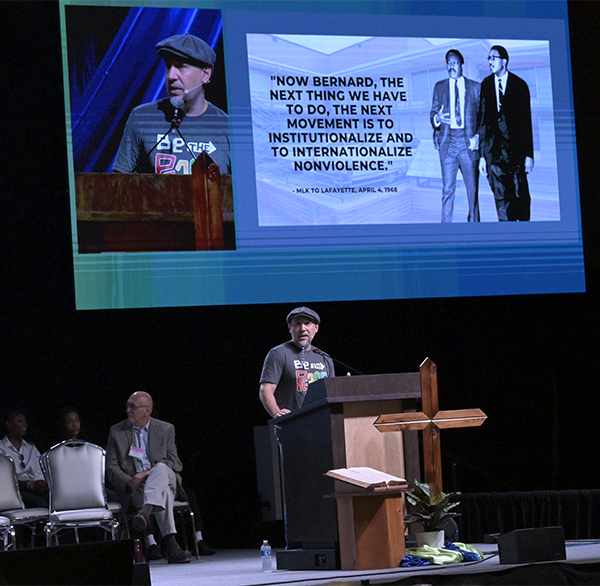
That led him to research the work of Bernard Lafayette, who passed away this year on March 6. Lafayette was an organizer with the Student Nonviolent Coordinating Committee who was also a leader in the Southern Christian Leadership Conference and helped coordinate the Poor People’s Campaign, among other work during the Civil Rights Movement.
Lafayette was with Dr. Martin Luther King Jr. at the Lorraine Motel on the morning of April 4, 1968. The last thing King said to him before he left to board a flight to Washington, D.C., was, ”Now Bernard, the next thing we have to do, the next move is to institutionalize and to internationalize nonviolence.” Later in the day, Lafayette learned King had been assassinated.
Angelo Mante told the Annual Conference about how he went to the Selma Center for Nonviolence to learn from Lafayette. He described his search for training on how to teach nonviolence. North Lawndale College Prep in Chicago worked to create a culture of nonviolence in their school, student led. It was a model.
As a result Mante, with the leadership of many teens in the Fort Wayne school system, has helped create Alive Community Outreach (www.alivefw.org). They started at Southside High School, a school of 1,400 students. Mante’s group worked to develop a three-week academy called Peacemaker Academy. Students would do this for three weeks, then coach others to support them in their work. Twelve students applied and were accepted for the first group.
Success was evident. With the support of the superintendent of the school district, Alive Community Outreach is present in all of the city’s high schools and is spreading into the elementary and middle schools as well, creating student peacemakers who are leaders in training and supporting other students.
Instituted during and despite the COVID-19 pandemic, Alive Community Outreach has enabled student leaders to help train more student leaders. Peace Club programs in all the schools proved to be truly transformational. Photographs showed youth delivering daily peace messages to the student body. The student leaders also produced thousands of short peace videos available to other youth through social media. Youth who have gone through the program ended up leading an in-service training for the teachers.
Fewer fights are not just a goal, but a byproduct of building Beloved Community. Students go to the Peace Room for mediation of conflicts. Mante added that more students are accessing the Peace Room.
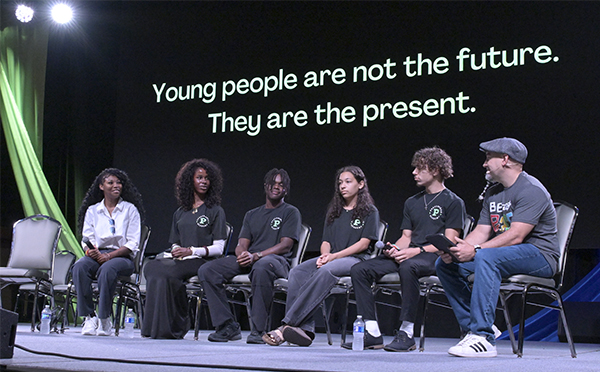
“Young people are not the future,” Mante emphasized. “They are the present…. So often we see our role (as adults) as preparing for a nebulous future, that adults are the leaders and have the power. We need to shift that. We need to equip young people to lead each other today, to adopt the humility and wisdom to know when to step back and follow their lead.”
Students who have gone through the Peacemaker program came onstage during Mante’s keynote presentation to the Conference, shared their own perspectives, and fielded questions.
Said one: “Seeing the impact it had on my friends and school made me want to get involved with that.”
Another emphasized that she learned “patience with both students and adults. Listening is a key part of what I need to do.”
A third said, “Peacemaking is not just a tactic, but a way of life.”
One student envisioned himself going into law enforcement, because incarceration as punishment instead of rehabilitation is not working. “Jail is a good place to institute peacemaking programs. It will be difficult, but I think it will work.”
And yet another put it best: “Nonviolence is a way of life for everybody.”
Find out more about Alive Community Outreach at AliveFW.org
— Frances Townsend and Frank Ramirez are members of the Annual Conference Press Team.
———-
Find more Church of the Brethren news:
- Brethren Volunteer Service Unit 340 completes orientation
- La Unidad 340 del Servicio Voluntario de los Hermanos completa la orientación.
- Inite Sèvis Volontè Frè yo 340 fini oryantasyon an
- New Pastor’s Manual in Haitian Creole and French to be used in Haiti and Africa
- Nuevo manual para pastores en criollo haitiano y francés para ser utilizado en Haití y África.