By Frank Ramirez
Conferencegoers who traveled to the old Woolworth’s building in Greensboro, N.C., which now houses the International Civil Rights Center and Museum, visited the original lunch counter where the Civil Rights movement’s lunch counter sit ins began.
On Feb. 1, 1960, four Black college students–Ezell Blair Jr., David Richmond, Franklin McCain, and Joseph McNeil–each took a seat at the segregated lunch counter and asked to be served a cup of coffee. They were refused that day. And the next day. And the day after that.
Following the nonviolent strategies of Martin Luther King Jr., they and many others took turns sitting peacefully, enduring insults and threats, and turning the other cheek to the haters–for the next five months, three weeks, and three days. The movement spread to 13 states and more than 50 cities before Woolworth’s changed its segregationist policies.
That lunch counter is preserved in a pristine fashion in Greensboro, where the museum exhibits chronicle both setbacks and successes in the history of Civil Rights in the United States. Some of the displays are profoundly disturbing, and serve as a reminder that the struggle for equal rights for all women and men in this country has not yet been achieved.
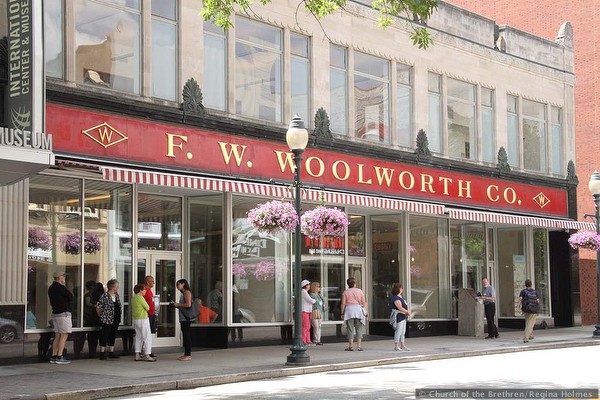
On the Thursday morning of the Annual Conference, a group of 36 Brethren toured the museum. One of those was Eric Anspaugh of Rocky Mount, Va., and a member of Central Church in Roanoke. His tour guide grew up in Greensboro and recalled her parents using the Green Book, the guidebook that listed the restaurants, gas stations, and hotels that were safe for African-American tourists as they traveled around the country in the 1950s and 1960s.
Ansbaugh said he hadn’t realized just how big the lunch counter sit in effort really was. “She told us how the four young men started the counter demonstration and how that grew,” he said. “I guess I didn’t realize just how long the sit ins went on, and how much the store really suffered. She told us that finally the store manager told the Black employees, ‘Change out of your uniforms. We’re going to feed you.’”
The docent warned the Conferencegoers that each person on the tour would experience one aspect of the experience more powerfully than the others. For Anspaugh, the exhibits that told the story about the violence against the demonstrators who crossed the Edmund Pettus Bridge in Selma, Ala., struck him most. Not long before, he and a friend had walked across the bridge with several others in silent commemoration of the Bloody Sunday events that took place on that bridge on March 7, 1965.
For those who missed the Conference tour but are interested in going on their own, the International Civil Rights Center and Museum is located at 134 S. Elm Street in Greensboro. In addition to the permanent exhibits there currently are two special exhibits: “I Am a Man,” focusing on the Memphis Garbage Strike; and an exhibit about Eugene Hairston, a Black teenager who is the only known lynching victim in Gilford County, which is the county where Greensboro is located. Contact the museum at 336-274-9199 or go to https://sitinmovement.org.
— Frank Ramirez is a retired pastor and a volunteer member of the Annual Conference Press Team.
———-
Find more Church of the Brethren news:
- Annual Conference moderator shares theme statement for 2027
- El moderador de la Conferencia Anual comparte la declaración temática para 2027.
- Moderatè konferans anyèl la pataje deklarasyon tèm pou 2027 la
- What faithful witness asks of churches today: CCT’s 20th anniversary forum
- Sa temwen fidèl yo mande legliz yo jodi a: fowòm 20yèm anivèsè CCT a