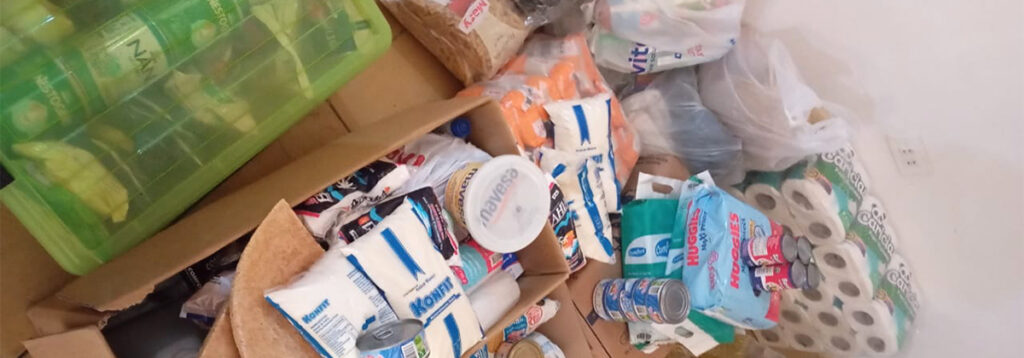
Brethren Disaster Ministries has directed the latest round of Emergency Disaster Fund (EDF) grants to support disaster relief work in the Democratic Republic of Congo, Venezuela, Honduras, and in the United States. Find out more about Brethren Disaster Ministries. Support this work by giving financially to the Emergency Disaster Fund.
Democratic Republic of Congo
$200,000 is aiding Eglise des Freres au Congo (the Church of the Brethren in the Democratic Republic of Congo) in a five-month emergency humanitarian aid program for families affected by the war in eastern DRC. The funds will provide humanitarian assistance to 1,776 households (roughly12,400 individuals) living in refugee camps in Burundi.
“The eastern Democratic Republic of Congo (DRC) remains in the midst of one of the most severe humanitarian and security crises in its recent history, now well into its third year,” said the announcement of the grant. “Since the M23 rebel group (operating under the banner of the Congo River Alliance, or AFC) relaunched its offensive in early 2025, it has overrun Congolese army (FARDC) forces in the largest cities in North and South Kivu provinces, displacing millions. Beginning with the fall of Goma in January 2025 and followed soon after by the capture of Bukavu in February 2025, M23/AFC has entrenched itself across vast stretches of both provinces, establishing parallel administrative structures and exerting direct control over people’s lives. Despite a peace agreement signed in Washington, D.C. in December 2025 between the DRC and Rwanda, and a subsequent Doha Framework Agreement, fighting has continued.”
The city of Uvira in South Kivu Province, where there is a Church of the Brethren congregation, is along the border with Burundi and has become a focal point in the crisis. The area has suffered greatly from the fighting, from displacement of its population and refugee needs, as well as sexual violence “perpetrated largely by M23,” according to the grant announcement. “Since January 2025, more than 90,000 Congolese refugees have crossed the DR Congo border into Burundi, seeking shelter, safety, and aid. The majority of these refugees are women, children, and the elderly.” Congolese Church of the Brethren leaders report that dozens of church families are among these refugees.
To support the Congolese Brethren, five EDF grants have provided targeted assistance since the invasion of Goma. This grant supports continuation of relief programing for the remainder of 2026 focused on the Bikinga-Busuma and Musenyi refugee camps in Burundi. This will include monthly cash assistance for food, medical needs, clothing, and household items for 1,086 households in the Bikinga–Busuma camp, targeting the most vulnerable families including female-headed households, physically and mentally disabled, orphaned or separated children, and the elderly; cash relief for 690 vulnerable households in the Musenyi camp; 3 weeklong Trauma Healing and Psychosocial First Aid training sessions for a total of 90 participants; and 3 one-day Gender-Based Sexual Violence prevention training programs for another 90 participants.
Venezuela
$55,000 supports the earthquake relief activities of the Church of the Brethren in Venezuela (ASIGLEH). This grant will allow programing to continue while longterm plans and budget development are completed in response to the double earthquake that hit the country on June 24. ASIGLEH reported no damage to any of their congregations and limited damage affecting church members, but is developing a plan to train, support, and deploy volunteers to provide care to others who have been affected and who are living in shelters. With an initial $5,000 grant in July, the church assessed the situation, met with potential response partners, and provided some initial relief of food and water. This grant will support programing including meals for families in shelters, special food for young children, social and emotional and spiritual support to survivors, educational support for children, household supplies including bedding and mattresses, medical supplies and first aid, and a special program providing for the needs of orphaned children in partnership with local girls’ homes.
United States
$15,000 supports the capacity of Child Life Disaster Relief to fund training initiatives and deployment services, provide training sessions for “Just-in-Time” Responder training, and support organizations responding to the needs of children affected by disasters. The latter includes Children’s Disaster Services (CDS), a program of Brethren Disaster Ministries, which is a partner organization. Since it was formed in 2016, Child Life Disaster Relief has been a close partner of CDS and its volunteers are trained Child Life Specialist professionals. Many also are trained as CDS volunteers and deploy with CDS.
In January 2026, a coalition of organizations focused on child-friendly safe spaces after disasters was created. These organizations include CDS along with Child Life Disaster Relief, Save the Children, and Project Camp. Each organization brings its own expertise to create a well-rounded support system for the coalition and to support children and their families after disasters.
Honduras
$8,800 supports a “Water for Home” program of Iglesia Cristiana Viviendo en Amor y Fe (VAF) in the Flor del Campo area of Tegucigalpa, Honduras. The church is a member of the Global Church of the Brethren Communion. The program will provide cash so vulnerable families can purchase water during the current drought in Central America. VAF reports water is provided by the government only every 9 to 15 days, and for only a few hours. For households that do not have sufficient storage containers, the water runs out long before the next supply cycle, forcing impoverished families to buy it on a recurring basis, at times choosing water over food.
Central America “is in the grip of a severe drought caused by a strong El Niño weather pattern,” said the grant announcement. “The Central American Dry Corridor cuts through Honduras, Guatemala, El Salvador, Nicaragua, and Costa Rica, with more than 10 million people across the region living in affected areas. The World Food Programme has identified Central America as the area facing the worst El Niño-related hunger impacts of any region, and the drought is projected to peak in late 2026, with the possibility of continuing into 2027. The impacts are hitting agriculture, livestock, and water supply all at once. Corn and bean harvests—the region’s staple crops—are being lost or severely reduced, driving up food prices and threatening food self-sufficiency. Cattle and other livestock are dying from hunger and dehydration. At the household level, water reserves in some communities have been restricted to urgent needs only, restricting household access to safe water, creating or exacerbating sanitation challenges and increasing risk of disease outbreaks. It also eliminates supplemental income sources like small-scale fish farming. Across Latin America, the WFP estimates as many as 16 million people could face food shortages, with child malnutrition emerging as a particular concern in Guatemala and Honduras.”
#MissionAndMinistryBoard #StrategicPlan #RacialJustice #LoveOurNeighbors #Discipleship #NewTestamentGiving
———-
Find more Church of the Brethren news:
- Deadlines for Eder to Everence transitions are fast approaching
- Se acercan rápidamente los plazos para las transiciones de Eder a Everence.
- Dat limit pou tranzisyon Eder pou ale Everence ap apwoche rapidman.
- David Steele to conclude service as Church of the Brethren General Secretary in August 2028
- David Steele concluirá su servicio como Secretario General de la Iglesia de los Hermanos en agosto de 2028