

He told so many lies he couldn’t keep track of them. That’s probably why he needed to type “A Brief Summary of Work Done by Leander Smith.” The list includes serving as a US congressman from 1897 to 1903, traveling to the Holy Land in 1907, and baptizing 180 believers in 1908.
Leander Smith assumed no one could unravel the truth of his life prior to 1910, when he showed up to pastor a Brethren congregation in Missouri. He had no way of anticipating the internet or Ancestry.com.
He was the grandfather of my husband, James Poling. The family had no reason to doubt Leander’s narrative of his past until Donald Durnbaugh was collecting information for The Brethren Encyclopedia. A Brethren minister who devoted his life to home missions west of the Mississippi, a man who’d been a congressman from North Carolina prior to being called to the ministry—surely, Jim thought, there should be an encyclopedia entry about him.
But Leander Smith’s name did not appear on any list of US congressmen.
Meanwhile, Jim’s parents, Virginia and Newton Poling, developed an interest in genealogy. They visited Virginia’s distant relatives, where they came across a family Bible. They spent hours in the Brethren Historical Library and Archives in Elgin, Ill., photocopying pages of The Gospel Messenger where Leander’s name was mentioned.
And they trusted that whatever was published in The Gospel Messenger had to be true.
Jim and I retired to North Carolina, a 40-minute drive from Burke County, where Leander was born in 1866. One day, out of curiosity, I visited the county library’s genealogy room. I brought along one piece of information: a The Gospel Messenger news item from 1911. Elder Leander Smith’s only daughter, seven-year-old Othella, had died back in North Carolina. “Her mother preceded her six years ago.”
I assumed it would be hard to locate someone named Smith. But the librarian quickly found a Leander and his daughter Othella in the 1910 census. There was another daughter, Ruth—and a living wife. It didn’t take long to trace Othella and Ruth Smith over the years. Othella died in 1977; Ruth died in 1988. And Leander’s dead wife? She lived until 1944. The census form also revealed that this was Leander’s second marriage.
If Leander Smith had lied about being a congressman and about the death of his daughter and second wife, what other lies had he told? What about his first wife? Were there other children? I was determined to unravel the mystery.
A two-page spread from a family Bible was photocopied by Jim’s parents. On the left side, in elegant cursive penmanship, were the names of Leander’s father and siblings—when they’d been born, when they died. At the bottom of the right side were four names crudely printed: parents and two sons, it seemed, with only birth dates. The parents were Elias L. Smith and Sarah E. Smith. Elias, I discovered, was Elias Leander. Sarah Emma was Wife #1, who lived until 1927.
Another page in the Bible was an account of Elias Leander’s religious journey. He was baptized at St. John’s Baptist Church in 1881; ordained to be a deacon in 1884; “liberated by the church at Corinth to preach, January 12, 188[smudge].” The church at Corinth was Corinth Baptist Church in Casar, N.C., home congregation of the parents of Wife #1, Sarah Emma.
So why did Leander Smith change denominations? Likely because Southern Baptists would not have permitted a twice-married man to preach. The same was true for the Church of the Brethren. But if the Brethren didn’t know? A few strokes of the pen and an envelope addressed to The Gospel Messenger took care of that. Plus, he planned to marry again.
He recognized that anything published in The Gospel Messenger was assumed to be true.
Apparently the Brethren didn’t require him to fill out the “Ministerial Record” until 1938. On the form he made no mention of having been a Southern Baptist. He stated that he’d been licensed in 1905 in Aquone, N.C., and later was installed and ordained there.
Why Aquone? Because nobody had heard of it. I found no evidence that a Church of the Brethren had ever been located anywhere near this small, remote mountain settlement in the far western part of the state.
Englevale, N.D., is the first verifiable place where Leander came into contact with the Brethren. According to History of the Northern Plains District Church of the Brethren, 1844-1977, in 1910 the congregation reported having 18 members, with Leander Smith as elder.
That year he must have been in North Carolina just long enough to be counted in the census.
Another question troubled me: How did he even know about the Brethren? North Carolina congregations were mostly in the northern part of the state. He lived in the southwestern Piedmont. There were a few congregations in Polk County, but the nearest one was approximately 60 miles away. These were horse and buggy days, when it took two to three days to travel 60 miles.
I gave Bill Kostlevy, Brethren archivist at the time, a call.
“An interesting man,” he said while looking at Leander Smith’s obituary. Submitted by Jim’s father, it mentioned Leander’s career in politics.
“Lies,” I said. Of course, I had to explain myself. “What I want to know is how he learned about the Church of the Brethren.”
Bill explained that the denomination was publishing millions of religious tracts at that time. Maybe Leander had come across one.
However he discovered the church, he began purchasing Brethren publications in 1907. His name first appeared on the list of ministers in the 1908 Brethren Almanac.
Leander was a master of self-promotion. Even Brethren historian Roger Sappington was fooled. In The Brethren in the Carolinas: A History of the Church of the Brethren in the District of North and South Carolina, he wrote about Elder Leander Smith’s role at the Downs Chapel church. Sappington’s research probably relied on news blurbs in The Gospel Messenger.
For a multitude of reasons, I’m pretty sure that Leander wrote the news items himself and that the Downs Chapel congregation existed only on paper. If Leander wanted to change denominations so he could be a minister, he needed visibility, a way to establish credibility. He could depend on Brethren believing that everything published in The Gospel Messenger was true.
After Sappington recounted the love feast, the sermons, the baptisms, he wrote, “In spite of all this activity, the Downs Chapel congregation was never included in the roster of congregations at the District Meeting.” Of course not, if it didn’t really exist.
On Aug. 1, 1908, Leander’s first article, “Importance of Right Thoughts,” appeared in The Gospel Messenger. His second article came out in September. After that, for 34 years, The Gospel Messenger regularly published his theological reflections.
Then in March 1910, there was an announcement: “MINISTER WANTED. There are a few members at Nevada, Mo., with a good church house, but without a resident minister. We appeal to those ministers who contemplate making a change to correspond with the writer.” Perhaps this was what Leander had been working toward. A chance to answer God’s call to preach. A chance to escape.
Two months before he was scheduled to leave for Missouri, The Gospel Messenger reported that the private home where Brother Leander Smith was staying had been destroyed by fire. His trunk containing his books and clothing had been lost in the fire.
Was this true? Or did he want Mary Jane, Wife #2, to believe he’d be away only a short while? Yet in Missouri he’d need an explanation for why he arrived with so few belongings. In any case, the 44-year-old minister left two wives and five or six children behind. He never returned to North Carolina. How did he get by with all this deception? Again, I contacted Bill Kostlevy.
Bill explained in an email, “The Church of the Brethren didn’t actually create a unified board structure until 1946. In 1908 the structure would not have been centralized.” So, there were no Elgin offices, no national staff. Districts operated on their own. And the people he knew from his previous life? They were Southern Baptists and would have had no access to his publications.
Were the Brethren naïve?
“A man’s word is his bond,” they taught. So they assumed Leander’s integrity. Maybe he had a compelling personality, this intelligent man with a charming Southern accent. Maybe they were impressed by what he wrote.
For if it was in The Gospel Messenger. . . .
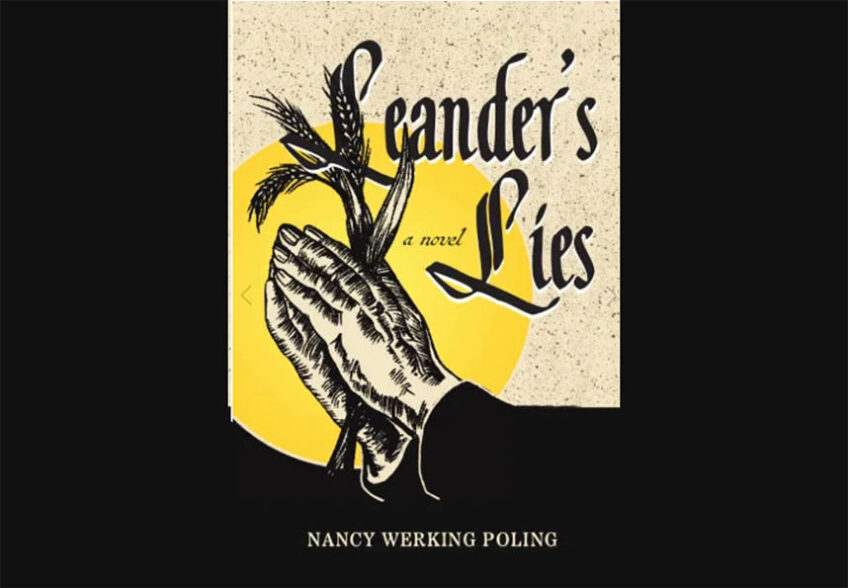
Nancy Werking Poling is author of Leander’s Lies, a historical novel, which is available through Brethren Press. She offers a disclaimer—that her conclusions about how he worked his way into the Church of the Brethren are conjecture. She also explains that the main character in the book is named Muller rather than Smith in order to avoid connections to descendants of his first two marriages.