

Mark 9:36-37, 42; 10:13-16
Recently there have been images shared on social media with phrases like “I can’t adult today.” This phrase, and others like it, have been printed on T-shirts and mugs, often accompanied by a cat or dog that looks weary and limp. It is meant to be a humorous depiction of the reality that being an adult and taking care of the daily responsibilities of independent living as an adult can be tiring and challenging. This stage of life also comes with autonomy and choice and power. Yet there are often pieces of the seeming simplicity of childhood to which we long to return.
Everyone who is an adult has, at some time and in some way, been a child who progressed into adulthood. Growth happens during life in all sorts of ways—including physically, mentally, emotionally, and vocationally. This shared experience of development serves as both a useful reality and a potential metaphor. In most social and cultural contexts globally, children have less power, which is the foundational assumption upon which Jesus builds.
Jesus’ teachings about welcoming children appear in all three of the synoptic Gospels (Matthew 18:1-5, 19:13-15; Mark 9:36-37, 10:13-16; and Luke 18:15-17). There are three pieces to these teachings. First, Jesus instructs the disciples that the one who is like a child is the greatest. Second, Jesus shares the metaphor of the millstone hung around the neck of the one who causes a “little one” to stumble. Third, Jesus indicates that the children will receive the kingdom of God.
In these teachings, Jesus actively centers a child in the midst of the gathered listeners, and suggests that their faith should be childlike, too.
A child among them
In Mark 9, midway through the Gospel narrative, Jesus sits down to teach the disciples. Previously, as they walked, the disciples had been arguing about which of them was the greatest.
It is hard to know how they measured their greatness. Maybe it was in terms of who had the most land or who was the oldest. Perhaps it was in terms of who thought they were the most intelligent or had the strongest argument in a recent ethical debate. It could have been greatness measured by physical strength or family lineage or frequency of spiritual practice. We might conclude, though, that when Jesus asked them about this argument, they realized its futility in their response of silence (v. 34).
Jesus upends the expectations of society and culture in many ways during his time of ministry. In this illustration, he counters what seems to be perhaps the most obvious and natural definition of who is greater. Of course, children are less powerful, at the bottom of the social ladder, and at the end of the line! Of course, children are smaller, weaker, lesser! And yet, Jesus claims, “Whoever wants to be first must be last” (v. 35). Greatness is redefined.
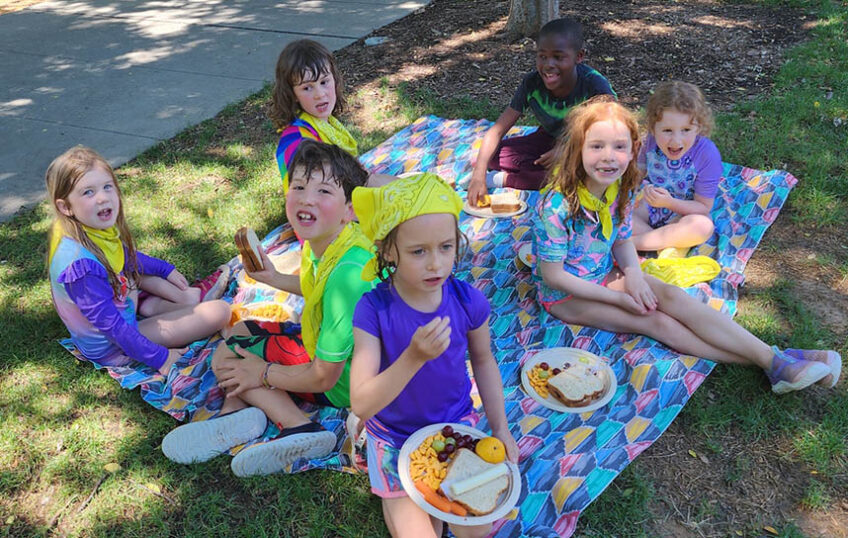
Children are prioritized as Jesus took a child and “put it among them” (v. 36). He centered the young one, the one viewed by the world as less, and gave it power of position. Jesus embraced this small person and gave it prioritized love and care. Jesus placed the symbol of their goal, to become childlike, right there in their midst, accessible to anyone who chooses this path.
Luke 2 reminds us that Jesus was a child among them from the very beginning of his story. God brought Jesus into the world as a human, but not as the type of human that we might think would be most logical or appropriate. God did not send Jesus to earth as an adult, grown and wise, with resources and experiences on which to rely. Instead, God became incarnate in an infant, a child, the exact opposite of what we might expect. Jesus as a baby became a child among them, announced by angels and visited by shepherds. The glory and power of the Messiah was not at all in the form that was anticipated. The shepherds were awe-struck by this news (v. 9). As they shared the message further, others were amazed as well (v. 18).
Humility and hospitality
As Jesus’ teaching about greatness and centering children is shared in Matthew 18, Jesus makes clear that his followers must “change and become like children” (v. 3). But in the version in Mark 10, the instruction goes in a different direction. There is certainly the implication that the disciples should become like children if they want to be part of the kingdom of God (v. 15), although they are not explicitly told to change. Instead, in Mark 9:35 and 37, the disciples are told that whoever desires to have power must actually relinquish power. Whoever is welcoming to a child, like the one in their midst, also welcomes Jesus and, therefore, the Holy One who sent Jesus.
This call to following Jesus requires humility. Even the disciples who walked with Jesus in the flesh struggled with understanding Jesus’ teachings and found it challenging to apply them to their lives. After fussing with each other about who is the greatest, Jesus makes it clear that actual power, authentic power found in God, is not about how we perceive greatness through our human eyes and minds. Instead, humbling ourselves, putting ourselves last, in the way that a child would have found themselves, is a true measure of the power found in the kingdom of God. Shrinking our hearty view of ourselves and instead expanding our view of others leads to this type of humility.
This call to follow Jesus also requires hospitality. Caring for others, bringing those close who seem very different—because of chronological age or amount of time as part of the church, for example—is an act of hospitality. Welcoming those who are perceived as weak, or “little,” is the hospitable thing to do.
Becoming like children
Don Kraybill writes in his book The Upside-Down Kingdom: “As the disciples vied for power and pushed toddlers away, Jesus used a child to symbolize kingdom values. Typically we tell people to grow up and ‘act their age.’ Jesus reverses the logic. He invites us to ‘grow down,’ to regress to childlike behavior” (p. 224).
Jesus is not suggesting that his disciples should stick their tongues out at one another or refuse to eat their peas. Instead, in Mark 10:15, Jesus is inviting his disciples to pursue a childlike faith, to “receive the kingdom of God as a little child.” This could look like the humility described above, an encouragement to those who strive for power to instead strive to elevate others.
This guidance to adopt a childlike faith also could look like faith that is more peaceful, more simple, and more dependent on one another. Children need and desire all those qualities! The Church of the Brethren has long used the tagline, “Continuing the work of Jesus. Peacefully. Simply. Together.” This emphasizes key aspects of the Anabaptist and Radical Pietist theological foundations of the denomination. The words also help us to focus faithful efforts in practice, engaging in ministries that seek to live out these characteristics.
This Bible study comes from the spring 2026 quarter of A Guide for Biblical Studies, published by Brethren Press. The quarter is co-written by Naomi Kraenbring and Liz Bidgood Enders, members of the pastoral team at Elizabethtown (Pa.) Church of the Brethren.